Around the turn of the millennium me and my girlfriend at the time, Angelica, decided to spend an Easter vacation in Aegina, a beautiful and serene little island just south of Athens. During that period Angelica was volunteering for the Greek Center for the Protection of Wild Animals (Ελληνικό Κέντρο Περίθαλψης Αγρίων Ζώων / ΕΚΠΑΖ / EKPAZ) in Athens, and we had both been volunteers at Greenpeace Greece for several years already. As such, we were in a sense insiders of the relatively small environmental movement of Greece. So, we were told that while we were in Aegina we could go visit the new facilities of EKPAZ on the island; they would be closed to the public due to Easter, but the personnel would be there, and they would be happy to receive us and show us around.
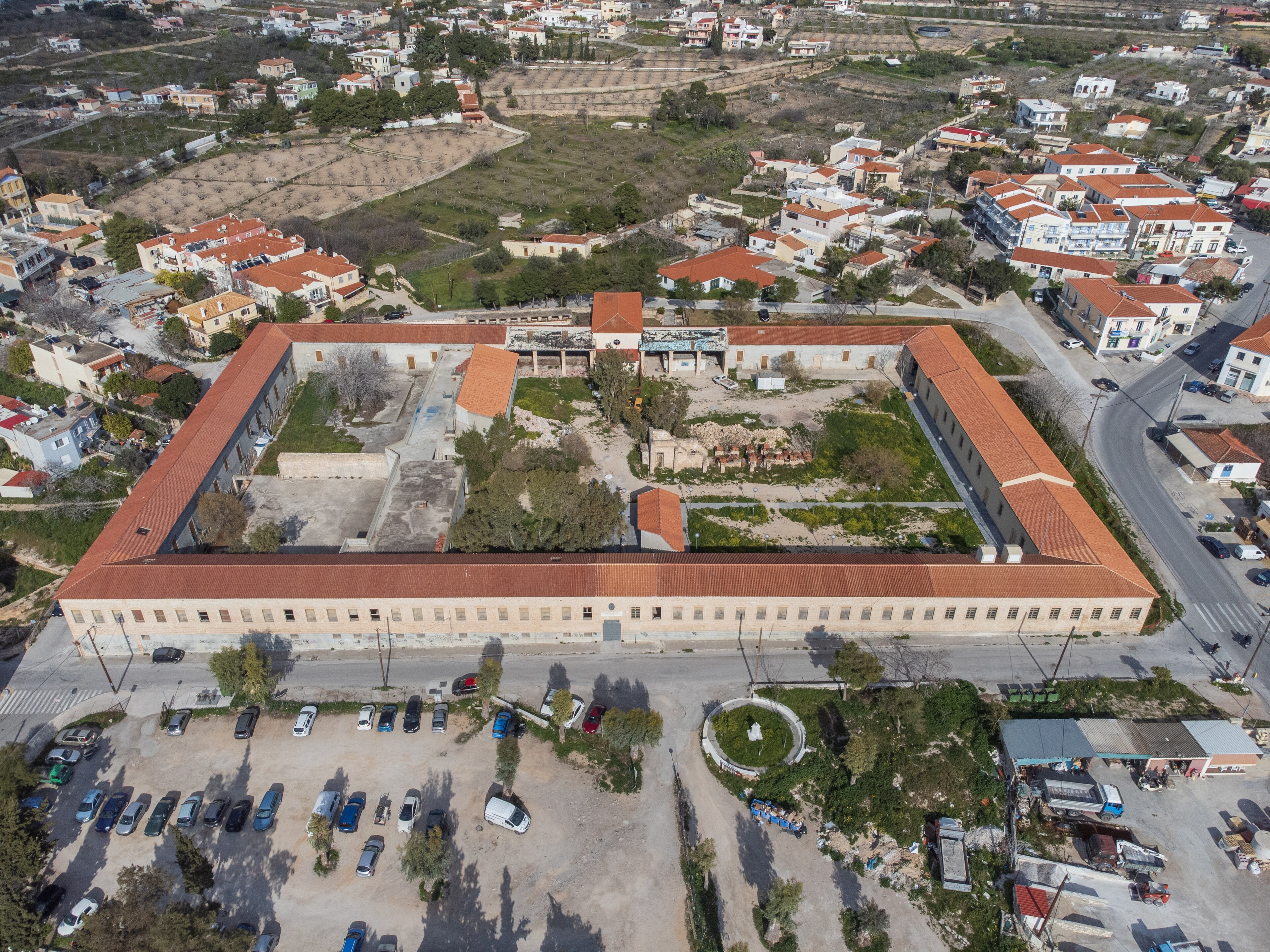
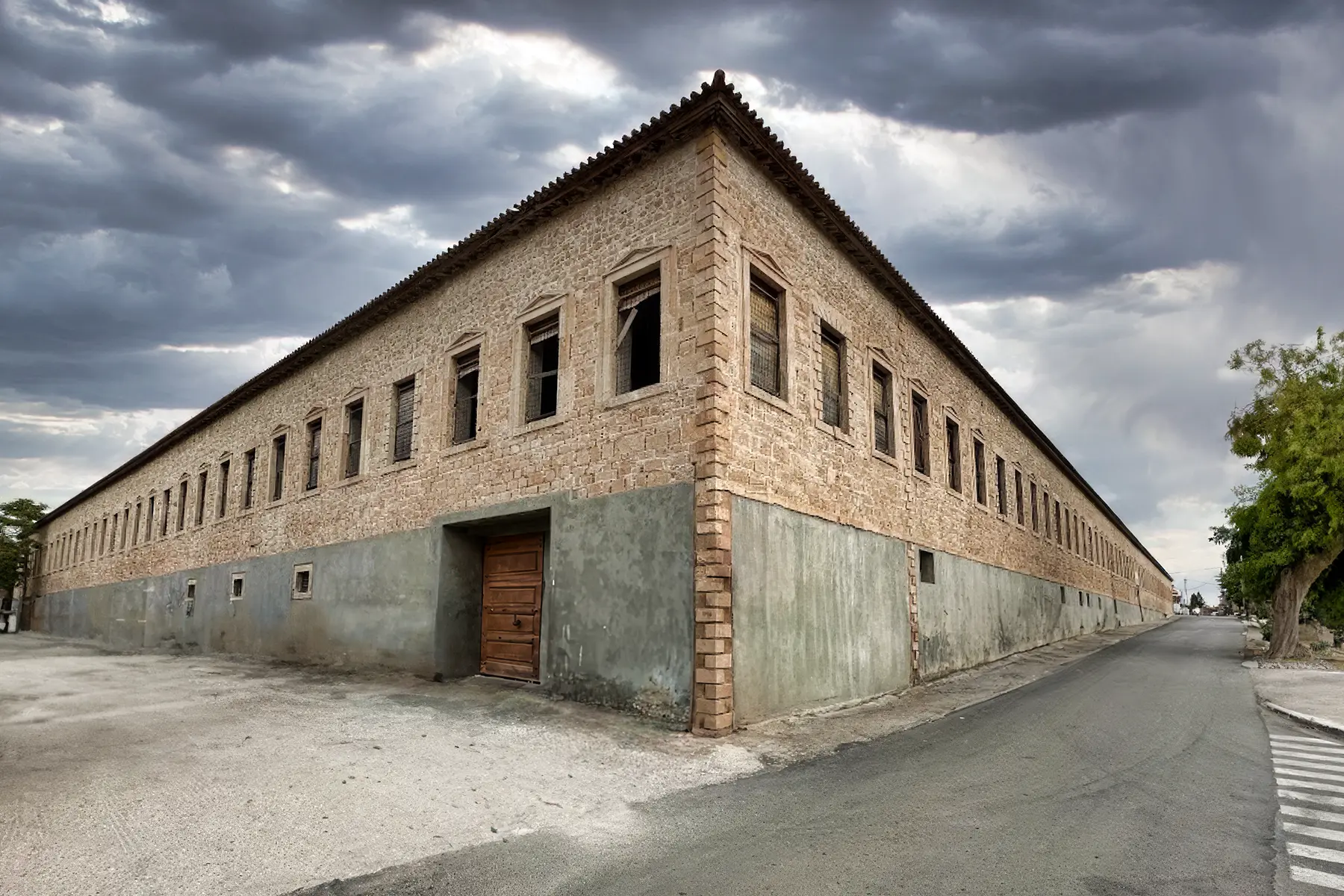
In previous years, EKPAZ had been housed in a very old building in the town of Aegina. Built in 1828, only one year after the modern Greek state was formed, it was the first public building, and for a long time the largest building in the country. It was originally built as an orphanage, then used for various purposes such as military academy, psychiatric hospital, quarantine station, refugee asylum, etc. but starting from 1880, and for more than a hundred years, it was a jailhouse, primarily receiving political prisoners.
 |
|---|
| Aerial view of the old jailhouse of Aegina; photo from wikimedia commons |
 |
|---|
| Street view of the old jailhouse of Aegina; photo from lalaounistravel.com |
 |
|---|
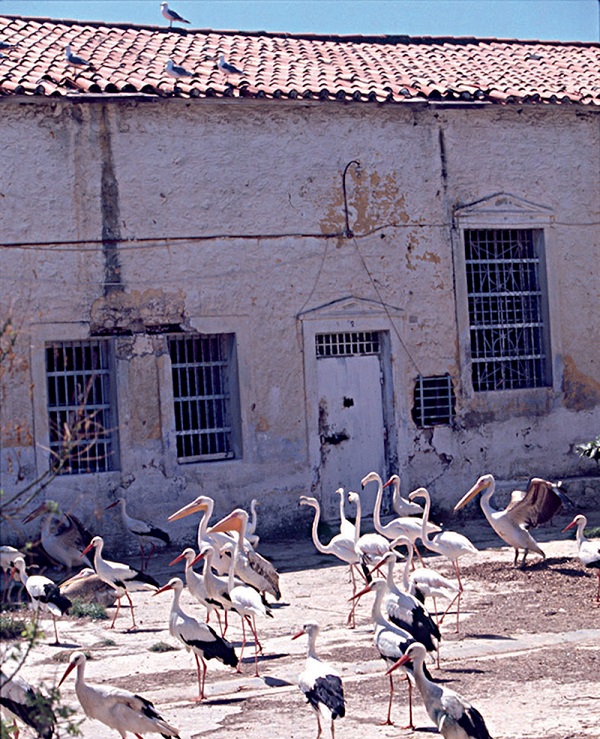
| Inside view of the old jailhouse of Aegina during the EKPAZ years; photo from ethnos.gr |
The jail was shut down in 1985 by the newly elected socialist government, and after that the building remained unused, because it required a very expensive restoration that nobody could afford. So, in 1990 the municipality allowed EKPAZ to use it as an asylum for injured wild animals, the idea being, I suppose, that the animals would not mind the decrepit state of the facilities.
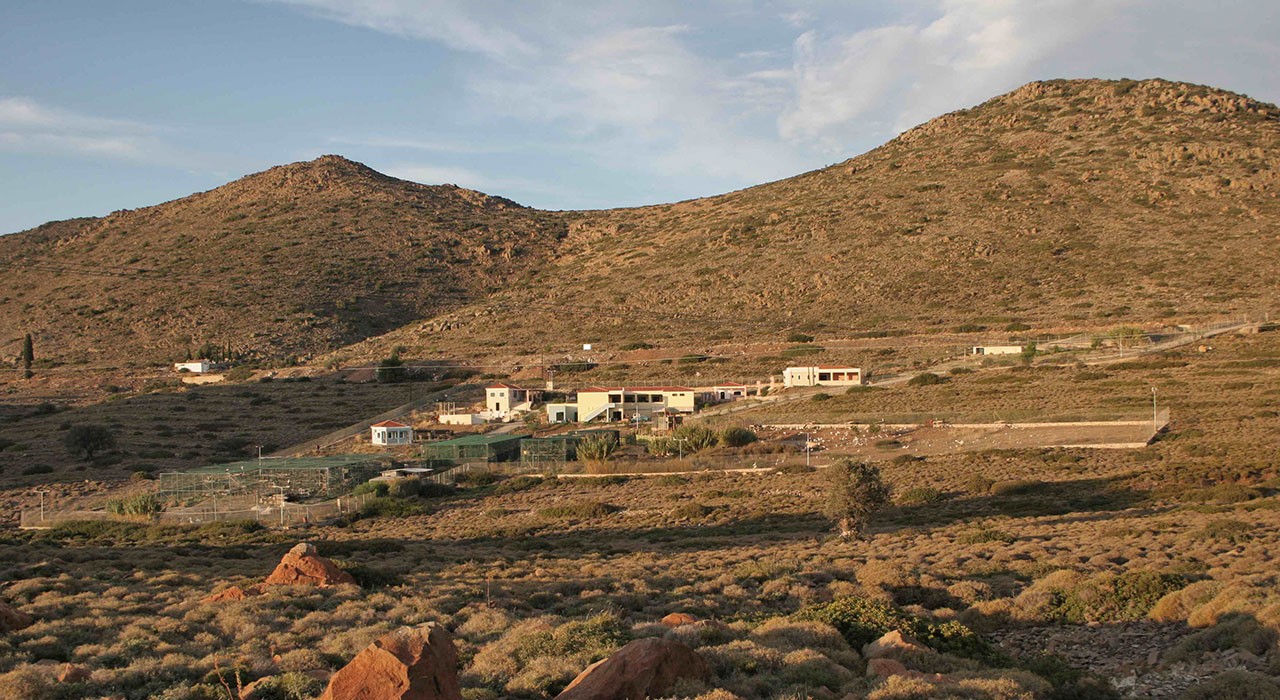
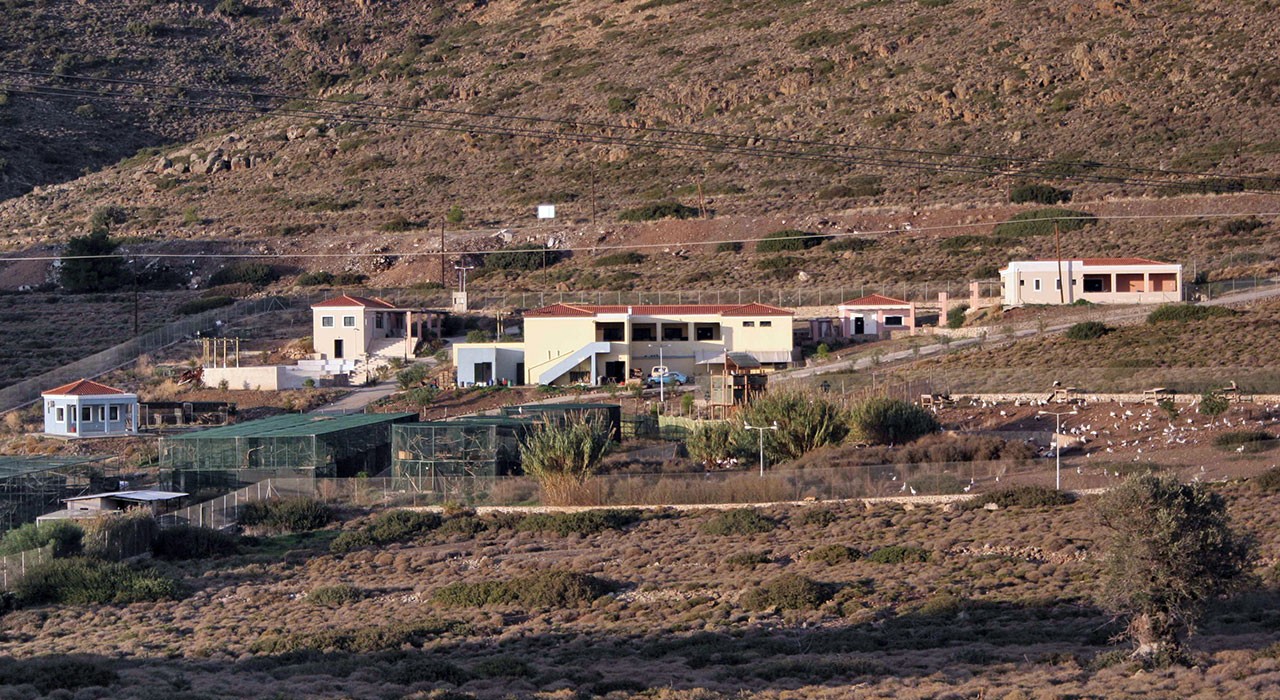
Then the municipality started making plans to turn the old building into a museum, so in 2001 they had EKPAZ relocate. This time the municipality granted EKPAZ a recently constructed building complex located on a gentle hillside in a somewhat remote and inland location of Aegina. The complex was originally intended as a cultural center, but it had never materialized as such.
 |
|---|
| The new facilities of EKPAZ, early 2000s; photo from ekpaz.com |
 |
|---|
| The new facilities of EKPAZ, (zoom,) early 2000s; photo from ekpaz.com |
I cannot say that I know how and why this cultural center that apparently nobody had a need for had popped up in the middle of nowhere, but it seemed to me like one more of those projects that are unfortunately common in Greece, which are undertaken with the sole intention of misappropriating European Union funds. The standard play is that a proposal is submitted for a work for which the EU will provide a 50% subsidy; the work is completed for only 10% of the cost, another 20% or so goes to pay taxes, (because invoices are issued for 100% of the cost, to justify the 50% funding,) and the remaining 20% or so, which may amount to hundreds of thousands of Euros, goes into the pockets of those involved in the fraud. The end-result is invariably useless. In this particular case, the location was too remote to be practical, and keeping the facilities running would have required a regular flow of money for which there was no budget. So, instead of letting the facilities rot, the municipality let EKPAZ have them. One thing is sure: for EKPAZ, the modern housing constituted a huge improvement over the old jailhouse.
And so on Easter Sunday of 2002 we went to visit the new facilities of EKPAZ. We were greeted by a handful of friendly faces; a couple of them were employees, most were volunteers. They had all gathered there on that day for a certain tradition that is very strong in Greece: the roasting of the lamb, happening each year on Easter Sunday.
This is one of the many paradoxes of the environmental movement in Greece: in any other country of the Western World, a large percentage of those involved with environmentalism, and especially those involved with the protection of animals, would be vegetarian if not vegan. This would have prevented the slightest notion of any kind of roasting of any kind of animal from coming up as a suggestion, but not in Greece, which has a virtually non-existent vegetarian culture. As a result, it is perfectly possible in Greece to see people attending to injured wild animals with determination, devotion, and self-sacrifice, while at the same time, a little bit further away, the exact same people are roasting an animal that had the misfortune of being neither wild, nor injured.
This is not to say that either me or Angelica were vegetarians; we were omnivorous like the rest, but as I like to say, "not fanatic about it". Apparently, we had some slightly different sensitivities. We did not indicate any great interest in standing around the roasting of the lamb, because it is, quite frankly, a ghastly sight to behold. So, it was quickly agreed that one of the volunteers would give us a tour of the facilities.
Being admitted in the place, despite it being closed to the public on that day, and then having a tour guide all for ourselves, made us feel like we were guests of honor. We were very grateful for that.
First we visited the veterinarian's cabin, which was a tiny house consisting of just one room, and maybe a bathroom. It was furnished with an examination table, and benches and shelves with medical supplies and equipment. I do not know much about medical things, but my impression was that it was decently equipped and certainly well kept. I am sure that more equipment would be useful, if only there was enough money to buy it. The lady working there was Maria Ganoti, a well-known figure in environmental circles in Greece. I suppose that people in her line of work do not take days off very often, because the injured animals will not stop arriving just because it is their day off.
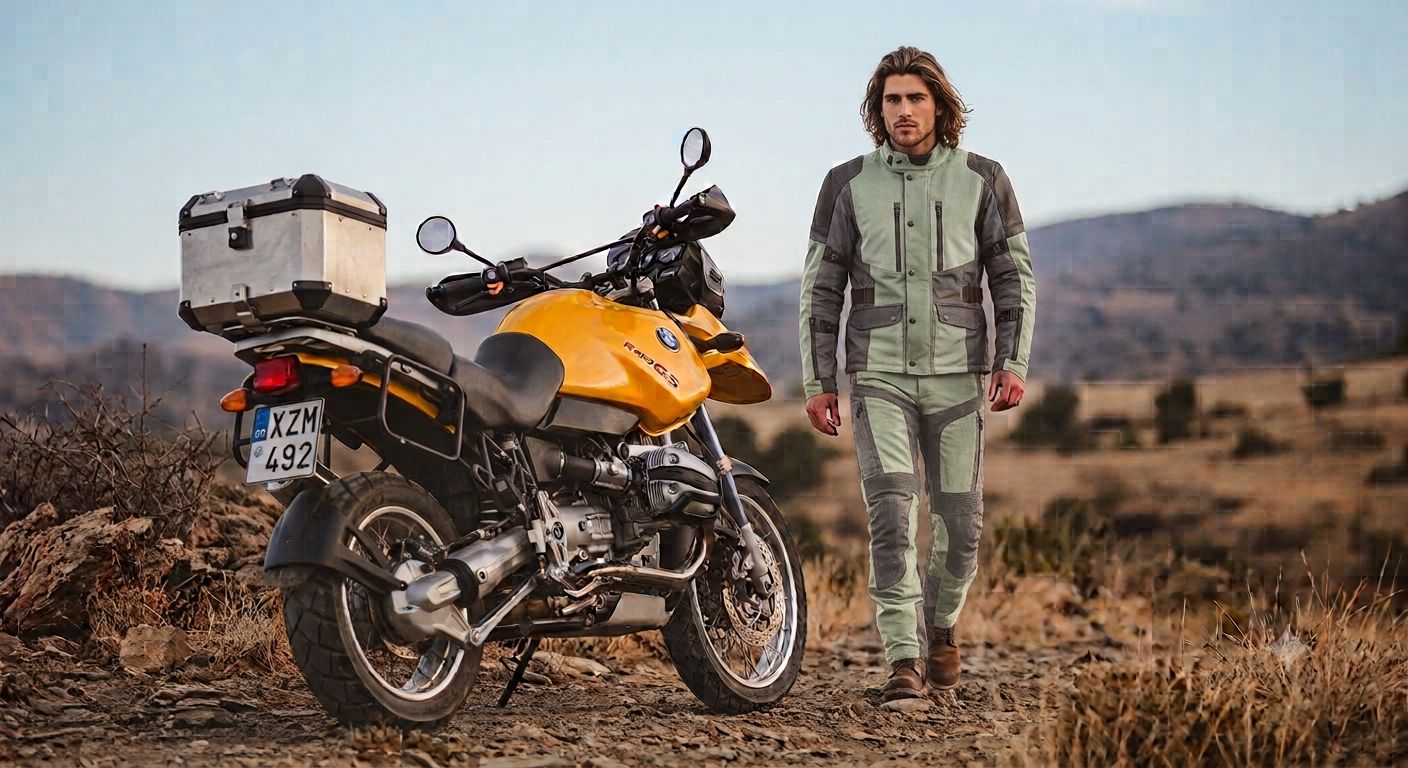
Sure enough, we were hardly done with the introductions when I saw through the window a motorcycle arriving outside, and parking in a hurry. It was a BMW R1150GS, as huge and formidable as expensive. The rider, dressed in impeccable (and also quite expensive) motorcycle gear got off the saddle, picked up a carton box from the luggage compartment, and rushed into the clinic.
He was a very tall, and ridiculously handsome young man. His long hair and unshaven look tried, but failed, to make him look particularly rough; you could tell he was a rich kid living the good life. I thought that he might be some kind of celebrity who chooses to invest his free time in activities with a noble cause instead of whatever it is that celebrities otherwise do with their free time.
 |
|---|
| A re-imagining of the motorcycle and the rider with the help of Google Gemini. |
In poor countries like Greece, where disposable income is rare, people tend to have more pressing needs to attend than the protection of the environment or the well-being of animals; thus, the affluent tend to be over-represented within the tiny environmental movement. Heck, come to think of it, even I could be considered as an example of this phenomenon: my comparatively decent salary of a Software Engineer gave me the luxury of not having to worry whether I would be able to pay the rent at the end of each month, and oh, look! what a coincidence, I was also there on a BMW motorcycle—albeit only an F650, which is half the size and less than half the price of an R1150GS—but nonetheless a symbol of Almost Certainly Making Ends Meet™. Quite often we are unaware of the privileges we enjoy.
The motorcycle man extended his arms with great purpose to hand the box to Maria. She took it, and he solemnly lowered his arms as someone whose mission had been accomplished. He stayed to see what was going to happen with the box. We were all very curious to see what was in it.
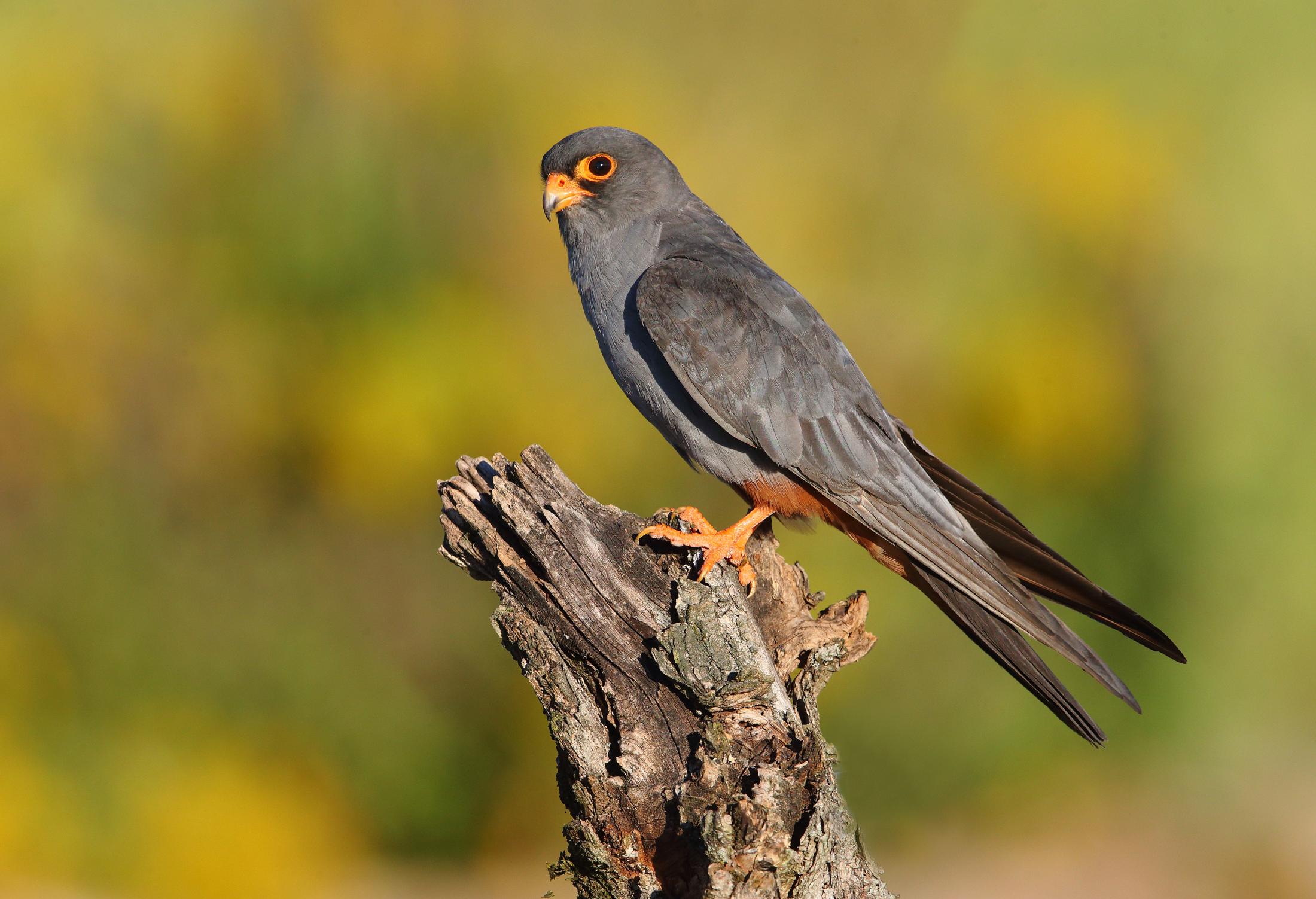
Maria opened the box, reached inside, and took out one of the most beautiful creatures I have seen in my life. It was a little falcon. His plumage was not particularly fancy, just a few shades of slightly bluish grey, (so, I suppose he was male,) but around his eyes and at the base of the beak he had those incredibly bright orange pigments that made him look completely out of this world. (Either that, or, I thought, I do not really know much about this world.)
According to research I did for this post more than two decades later, he must have been a Red-footed falcon (falco vespertinus). The Greek name appears to be Μαυροκιρκίνεζο. This photo that I found barely does any justice to what my eyes saw back then: the photo is very, very nice; what I saw was incredible.
 |
|---|
| Red-footed falcon, photo by Michele Mendi, from lipu.it |
Maria held the little falcon in her hands, and with her fingers she carefully felt every millimeter of it. Within a few moments she knew what was wrong with the little fella: he had a broken wing. She started to apply a bandage that would immobilize it and allow it to heal. She did it with such dexterity that it was obvious that she had done the same thing an untold number of times before.
We considered ourselves very lucky and grateful to be given the opportunity to witness that incident and to see Maria at work.
Since I was involved with Greenpeace, an organization which, contrary to popular belief, is not involved in the rescue, rehabilitation, or sheltering of wild animals, I could not help but bring to mind some of the nuances of the situation: Greenpeace does environmental campaigns, political lobbying, legal actions, and nonviolent direct actions with the intention, among other things, of protecting wildlife by preserving their natural habitats, or by bringing an end to human activities such as whaling. However, Greenpeace will not do anything for an individual wild animal in need of help, other than perhaps contacting another organization that specializes in that type of thing. From the perspective of Greenpeace, injured wild animals like that little falcon are but statistics.
Now, do not get me wrong: of course I did deeply care for that particular little falcon, and I was glad that he was being cared for, and I sincerely hoped that he, personally, would make it; but from a global perspective, the rescue of that particular little falcon was probably not the best use of the resources of the environmental movement as a whole. I try not to worry about it too much, but it is worth keeping somewhere in the back of the mind that we do not have the resources to transport every injured wild bird by BMW R1150GS.
Wildlife rescue can, in a sense, be thought of as collectively being too busy mopping the floor to turn off the faucet. In fact, we rescue wild animals largely because it makes us feel better, not because it is the most effective thing we could be doing to solve the problem. That is what Greenpeace tries to optimize, and that is why Greenpeace is different; but of course, the human need to be compassionate, the bearing of witness to suffering, and the immense urgency of a life about to be lost unless cared for, cannot be brushed aside. And so here we are, at EKPAZ.
We proceeded to a building where many injured wild birds were kept. There were storks, cranes, flamingos, swans, herons, pelicans,, and other kinds of birds that I don't even know their names. They all seemed pretty miserable. Our guide assured us that they were all going to make it, they just had to stay in the facility for a while to recuperate, but they would eventually regain their health and most of them would be released back in the wild.
EKPAZ was performing releases of wild animals about twice a year, and they often organized them as events that people could attend and witness. We had actually attended such an event the year before.
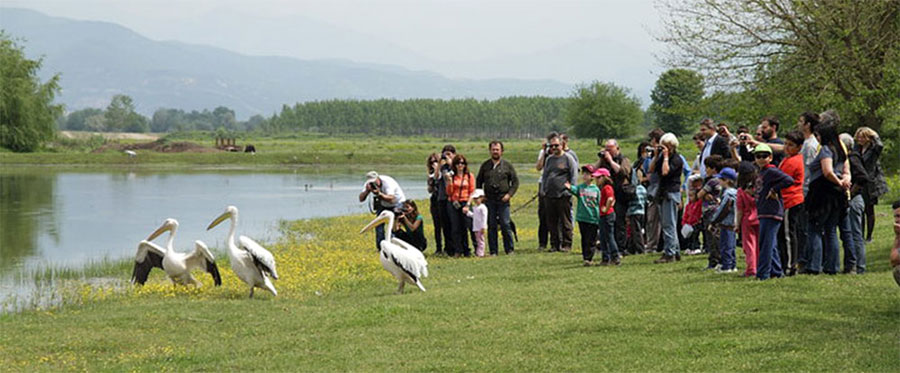 |
|---|
| A release event by EKPAZ; from ekpaz.com |
We inquired about the causes that resulted in these birds being there, in need of care. As it turns out, in virtually all cases, the cause is humans. She said that a small percentage of the cases are accidents; for example, birds with a large wing span may, on a rare occasion, be shocked by overhead power lines. Those are the cases where humans were only indirectly responsible. However, she said that the vast majority of those birds were there because they had been shot by humans.
And that, despite the fact that all of them belong to species that are never legal to hunt.
This is the sad reality of "sport" hunting in Greece: laws and regulations governing hunt exist like in any other civilized country; shooting those animals is a criminal offense; but the state lacks the resources necessary to enforce the laws, and many, if not most hunters, regard them as having a purely decorative function.
The last time a Greek chose to die in order to be in abidance by the law was two and a half thousand years ago.
Keeping such a large number of birds in an enclosed space had a very unfortunate consequence: the room stank with not just the worst stench that I had ever experienced in my life, but I would dare say, a stench that was worse than any stench imaginable. Our guide did not seem to have much of an issue with it; I suppose it is something that you get used to after a while; but while I stood there, I started feeling like I was under physical assault. When we exited the building I was very glad to be able to breathe again.
Then we started walking down a paved path, towards a little house that stood apart from the rest of the buildings.
While on that path, we admired the beautiful view ahead of us: through an opening between two hills on either side we could see some more of the hills of Aegina, then a bit of sea, (part of the Saronic gulf between Aegina and the Peloponese,) then out in the distance a Peloponesian mountain range, and then out in the extreme distance yet one more Peloponesian mountain range. For the needs of this post I managed to find a photo showing that exact same view, albeit under somewhat hazy conditions.
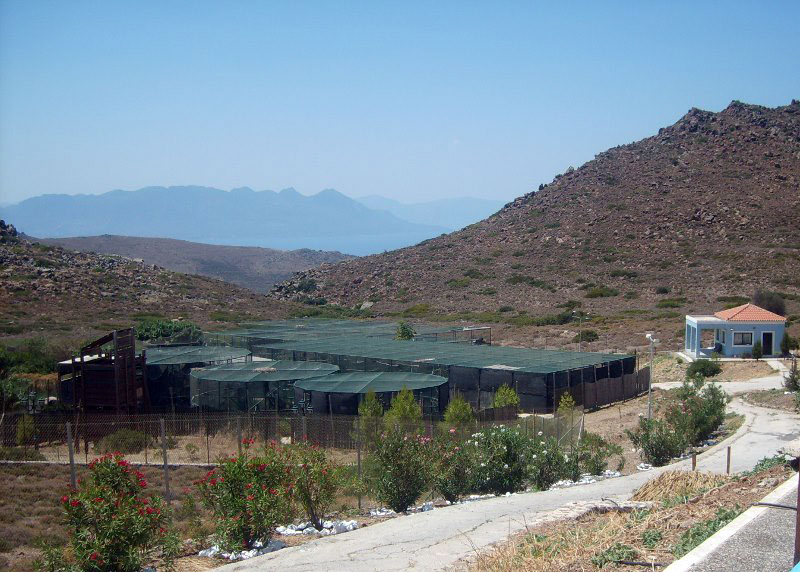 |
|---|
| Paved path with a view, leading to small house; photo from ekpaz.com |
The path led us in front of the outdoor cages, which were for animals that were in a bit better shape than the ones in the enclosed building.
I think we saw only one animal that was not a bird; it was a wild boar. One might wonder how come the vast majority of animals under the care of EKPAZ are birds. I do not know for sure, but I think the answer has to be something along these lines: we humans have almost wiped out all indigenous wildlife in Greece, and continue to murder whatever small populations are left; those populations are so small by now, that injured individuals in need of care are very few and far apart. In contrast, almost all birds are migratory; the north ends of their migration paths tend to be far away north of Greece, and the south ends are far away south, which means that for a large part of the year they live elsewhere, so as much as we would want to, we do not get the chance to exterminate them. But on each migration season, the land is inundated with large numbers of wildlife available for the slaughter. So, in a few words, the over-representation of birds in EKPAZ probably reflects the fact that almost no other wildlife exists in the country anymore, and the birds exist only because they are passing by.
That having been said, EKPAZ will provide care for any wild animal as long as they have the means for it. Years ago they used to have wolves, up to nine of them at one time. However, in 1992, Arcturos was founded in Northern Greece, an organization specifically for the protection of bears and wolves. So, soon afterward, EKPAZ handed their wolves over to Arcturos.
I was once told that at one point EKPAZ even had an arctic fox. Nobody really knows for sure how an arctic fox was found roaming the streets of suburban Attica, but in all likelihood she had escaped from some unknown, clandestine, and illegal operation that raises them for their fur.
EKPAZ has no means of providing care to aquatic animals, but luckily there exist other organizations in Greece that care for those, such as The Sea Turtle Protection Society of Greece, (Archelon,) the Hellenic Society For The Study And Protection Of The Monk Seal (MOm,) and a few others for dolphins, whales, etc.
Back to our tour of the EKPAZ facilities, I was glad to see that the cages for the large birds were spacious, allowing them some freedom of movement. Especially the one for the vultures was huge. We stopped in front of it to look at the vultures. I had never seen one before.
Vultures are very rare in the wild. The conservation status of each of the four different types of vulture that exist in Greece is as follows:
Egyptian Vulture (Neophron percnopterus): Critically Endangered (CR). Reduced to just about 5 breeding pairs nationally. 1, 2
Bearded Vulture (Gypaetus barbatus): Endangered. Extinct on the mainland; last remaining population (about 7–8 pairs) restricted to the island of Crete. 1, 2
Cinereous/Black Vulture (Aegypius monachus): Vulnerable (Nationally). Very last breeding colony in the entire Balkans, numbering around 28 to 35 pairs. 1, 2, 3, 4
Griffon Vulture (Gyps fulvus): Vulnerable (Nationally). 20–30 scattered pairs in the mainland, ~700 individuals on Crete providing some hope for the species. 1, 2, 3, 4
Despite vultures being so vanishingly rare in the wild, there is a much larger than expected percentage of them at EKPAZ. Of course, this is happening, because they are disliked by people, so they get shot more often. Due to their scavenging nature, many consider them as unclean, macabre, bad luck, and what not. So, I suppose that "sport" hunters who would have it at nothing to shoot a stork when bored, would probably go out of their way to shoot a vulture. Of course arbitrary human prejudice reigns supreme over naturalist nonsense like compassionate conservation, respect for all of nature, etc.
I could not help but briefly think of the statistics:
- Of all birds that are hit by birdshot:
- Four out of five are killed instantly, only one out of five gets away alive with injuries.
- Of those that sustain injuries:
- A tiny fraction like 3% to 5% survives on their own; the vast majority die of their injuries later, unless they are rescued.
- For a bird to be rescued:
- It must be found by humans. (The vast majority are never found.)
- The humans must have nothing to do with hunting.
- The humans must go out of their way to inquire what one is supposed to do when one finds an injured wild animal, and find out that one is supposed to contact EKPAZ.
- The humans must contact EKPAZ, which will give them instructions on how to ship the animal to EKPAZ.
- The humans must, in their own free time, do what is necessary to have the animal shipped to EKPAZ;
- The animal must be still alive by the time it arrives at EKPAZ.
- The humans must, in their own free time, do what is necessary to have the animal shipped to EKPAZ;
- The humans must contact EKPAZ, which will give them instructions on how to ship the animal to EKPAZ.
- The humans must go out of their way to inquire what one is supposed to do when one finds an injured wild animal, and find out that one is supposed to contact EKPAZ.
- The humans must have nothing to do with hunting.
- It must be found by humans. (The vast majority are never found.)
- For a bird to be rescued:
- A tiny fraction like 3% to 5% survives on their own; the vast majority die of their injuries later, unless they are rescued.
- Of those that sustain injuries:
- Four out of five are killed instantly, only one out of five gets away alive with injuries.
Those exceedingly few birds that had the incredible luck to reach EKPAZ still alive were the ones that we were looking at in the cages in front of us. So, a fair estimate of the situation is that for each one of the hundreds of birds at EKPAZ, thousands of other birds had died of shotgun injuries, and the downing ratio that we know from surveys says that four times that many more had been shot dead. Almost all of them belonging to species that are never legal to hunt.
What is wrong with humans?
We started walking along the last segment of the path, towards the little house at the end of it.
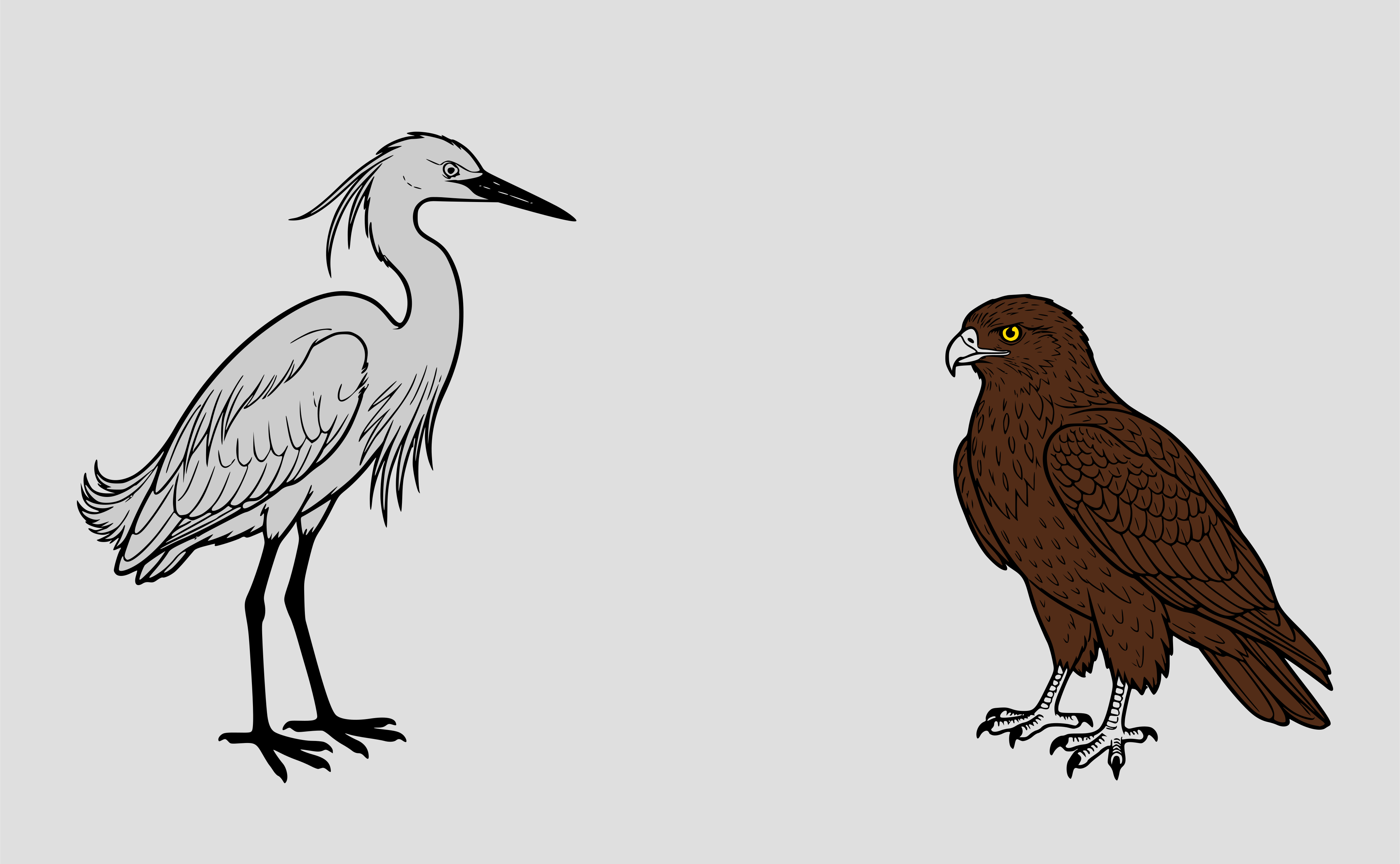
Already from a distance I noticed something strange: two birds were standing in front of the little house, a couple of meters from each other, motionless, doing nothing in particular. One was brownish, short, and stocky, the other was white, tall, and slender. I found that very odd. I looked hard, to rule out the possibility that they were in cages that I could not see, perhaps cages made of net, but that was not the case. The birds were just standing out there in the open. I could not explain this. I would have expected those birds to either be in cages or to have flown away.
As we drew closer, I could tell that the brown one was a hawk, and the white one was a heron. Each of them looked quite all right; it was not like they were missing plumage or body parts. How could these two birds, belonging to very different species, be simply standing at such close proximity to one another? And why would these birds even be there?
I thought that perhaps they had come to eat the food intended for the birds in the cages, but I immediately crossed out that theory because Aegina is very far away from their natural habitats: the heron likes rivers, lakes, and sweet-water wetlands, while the hawk roams the woodlands of mainland Greece, not the barren little islands of the Aegean sea. So, what on earth were those two birds doing there?
Seeing that they were standing motionless, I seriously considered for a moment that they might be embalmed. Of course it is preposterous to think that EKPAZ would have placed two embalmed birds there, but not as preposterous as suggesting that two such birds would have chosen by themselves to come and stand there. But then I noticed a tiny bit of movement, so the embalmment theory went down, too.
The mystery only thickened as we approached, and the birds did not seem to have any interest in flying or even walking away; however, I noticed that our guide was walking towards the birds without showing any signs of surprise, so I figured that this is normal, and it somehow ends up having a logical explanation, which was bound to be revealed shortly.
For the purposes of this post I found photos of two birds that look exactly like those two at EKPAZ.
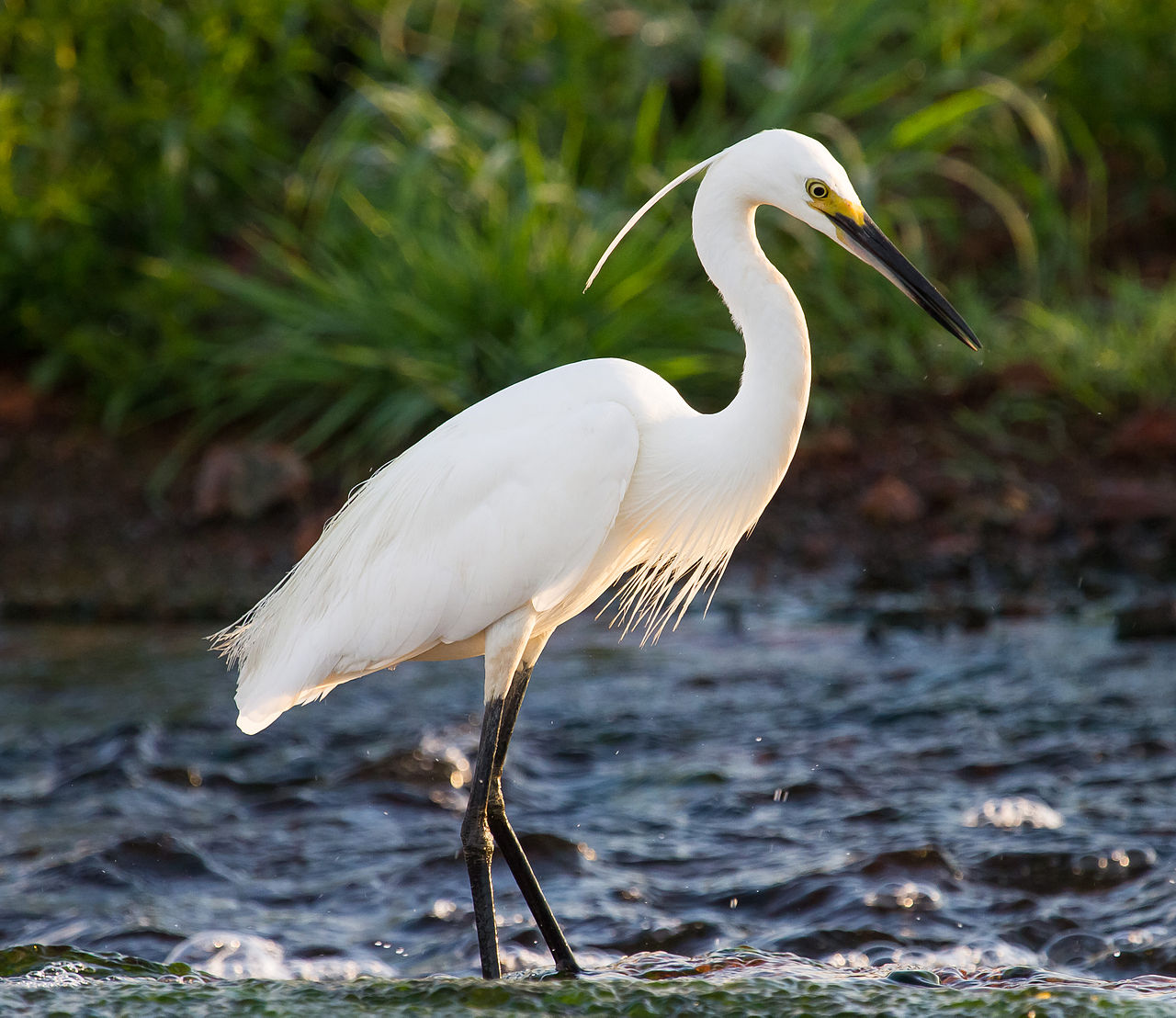 |
|---|
| A white heron (little egret) (Wikipedia); from Wikimedia Commons. |
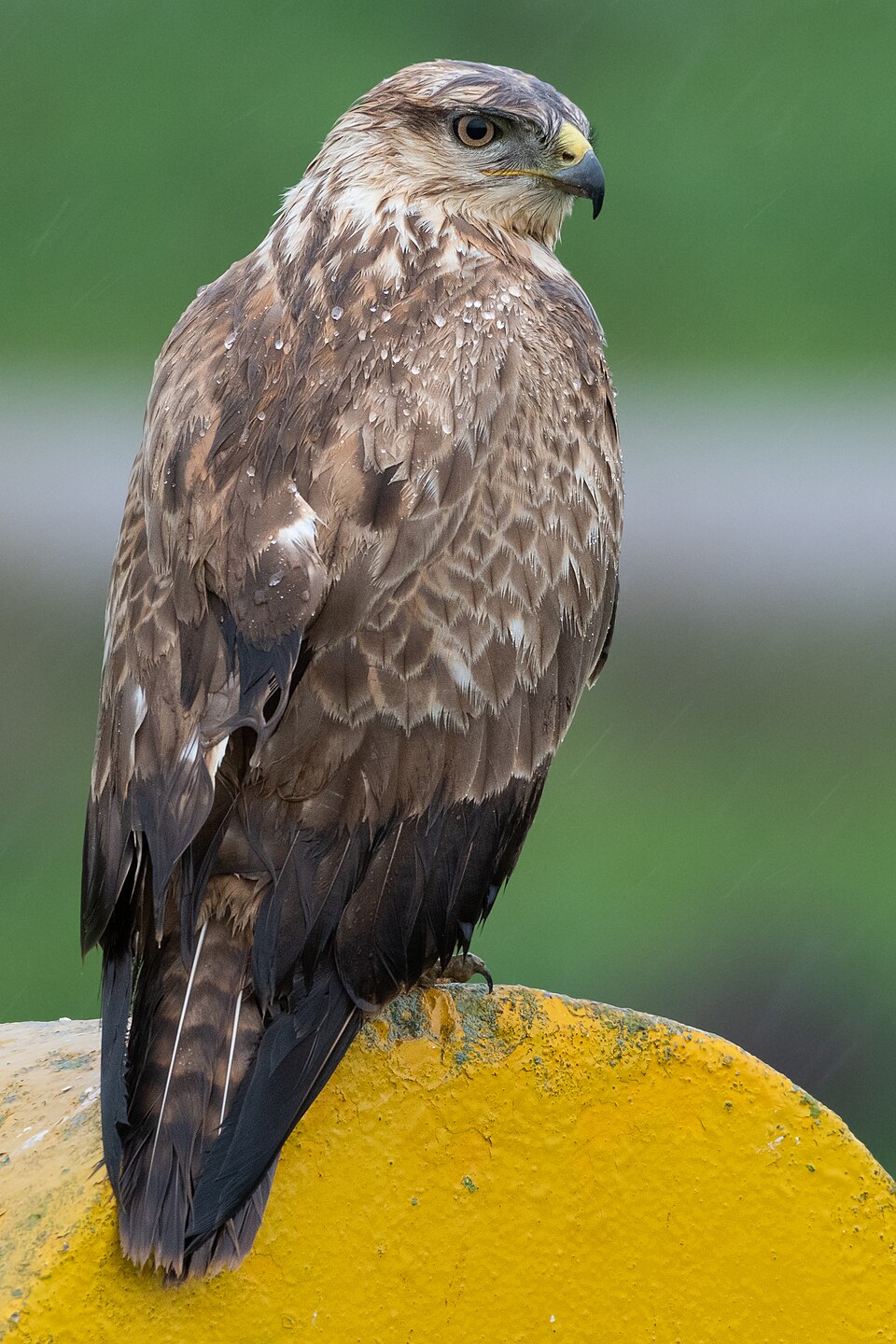 |
|---|
| A hawk (long-legged buzzard) (Wikipedia); from Wikimedia Commons. |
We were now standing among the birds, practically towering above them, looking at them just as they were looking at us, with their shiny, vigilant, piercing eyes, those marvels of nature that give them a 360-degree view of their surroundings with a level of detail that we humans could only dream of. Both of them looked healthy and beautiful. I could not believe we were so close to them, with nothing separating us, so that we could touch them if we wanted to, and yet they were just standing there, not minding our presence at all.
Our guide went inside the little house and came out holding a bag of some kind of birdfeed. We heard the distinctive sound of dozens of little pellets hitting metal as she poured some of the bird feed into a container that was on the ground nearby. Gently, and gracefully, the heron walked over to it, and started eating.
Then she went back inside, and came out again, this time holding a piece of raw meat, about the size of a small schnitzel. She put the meat on top of a rock that must have been there for that purpose, and then she lifted the hawk with her hands, (the hawk, incredibly, not minding at all,) and placed the hawk on the rock, right on top of the meat. For a brief moment the hawk kneaded the meat with his feet, and then started shredding it with his claws and eating it.
Finally, our guide explained.
She said that both those birds were in perfectly good health, except for one thing: they were both blind. She said that even though there was nothing obviously wrong with them, their optic nerves had been severed by birdshot.
Then she said something that struck me at first as an interesting new fact, but then immediately as so self-evident that I should have guessed on my own:
A blind bird will not fly.
So, those two were among the substantial percentage of guests of EKPAZ that were never going to be released. They were staying there for life.
I turned my face towards the lady as to keep my welling eyes hidden behind the sunglasses, but to no avail: gravity dragged the teardrops down my face.
We moved on.
The friendly people of EKPAZ invited us to stay and have lunch with them, but added that we would have to wait some more, because the lamb had taken a lot longer than they had expected to properly roast. So, it was not ready yet, despite it being something like 3 o'clock in the afternoon. They seemed to be rather inexperienced in this, and I entertained the thought that this was perhaps in some sense to their credit: maybe none of them had roasted a lamb before.
Due to a combination of factors having to do with the whole experience of visiting the facilities being a bit overwhelming, plus neither of us particularly caring for the taste of lamb, or for participating in traditions, we thanked them, and told them that we would prefer to return to the town. Both of us were very thankful for having been invited and shown around. I felt changed, as a person, by the experience.
Cover image: Heron and Hawk, created by Google Gemini from a prompt by michael.gr, then traced using InkScape to convert to svg, and then edited as svg by michael.gr.